QAR-ENOSH robotic cognition
A Surface Acoustic Wave-Driven Embodied Cognitive Architecture for Adaptive and Safe Robotic Intellige
DOI:
https://doi.org/10.66661/ENOSH-2026-002Keywords:
embodied robotic cognition;, surface acoustic wave sensing, cognitive skin, industrial welding robot, sensor placement, safe adaptive controlAbstract
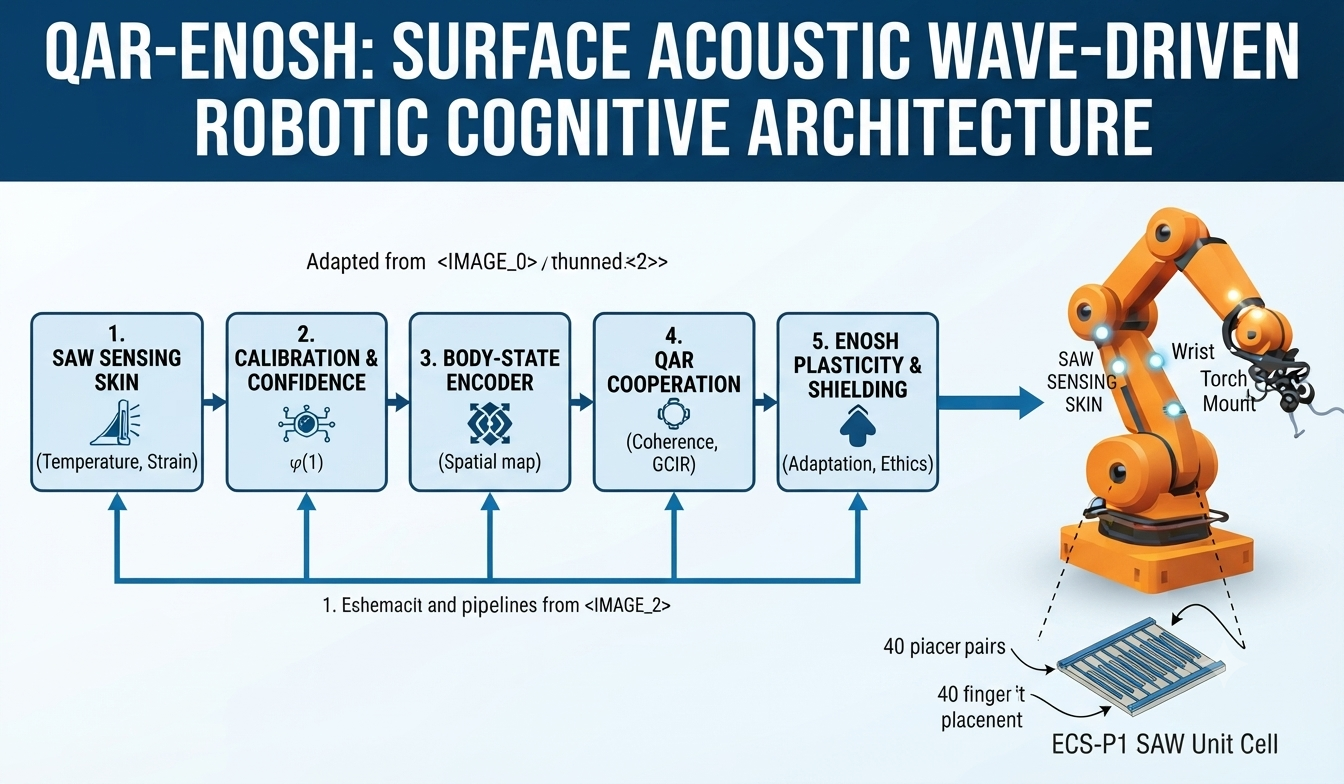
Embodied robotic intelligence requires distributed sensing of contact, temperature, strain and vibration, together with adaptive learning and independently enforced safety. This study extends the previously formulated QAR-ENOSH theoretical framework into a robotic engineering architecture and evaluates a proof-of-concept deployment on a generic six-degree-of-freedom automotive welding arm. Surface acoustic wave cells form an ENOSH Cognitive Skin that supplies confidence-weighted body and environmental observations to a coherence-guided learning layer. A nine-step computational pipeline separates sensing, calibration, state estimation, policy formation, plasticity and action shielding. Eight candidate sensor sites were ranked using an explicitly defined weighted observability score combining thermal sensitivity, vibration sensitivity, strain observability, survivability and maintainability. The wrist and torch mount ranked highest, with scores of 0.7642 and 0.7422, while a base sensor was retained as a global vibration reference despite its lower local score. A 10,000-sample weight-perturbation analysis preserved the wrist and torch mount as the two highest-ranked sites in every trial. The ECS-P1 prototype was specified as a 125 MHz two-port lithium-niobate delay line with a calculated wavelength of 31.824 micrometres and 7.956 micrometres finger width and gap. Results establish a reproducible design baseline, not measured industrial performance, for subsequent fabrication and robot validation under controlled welding task conditions.
References
El Noshokaty, I. Y. (2025). The engineered mind: Transitioning from quantum acoustics resonance to enhanced neuro-oscillatory synaptic heuristic. Independently published.
Mandal, D., & Banerjee, S. (2022). Surface acoustic wave sensors: Physics, materials, and applications. Sensors, 22(3), Article 820.
Ballantine, D. S., White, R. M., Martin, S. J., Ricco, A. J., Zellers, E. T., Frye, G. C., & Wohltjen, H. (1997). Acoustic wave sensors: Theory, design, and physico-chemical applications. Academic Press.
Hashimoto, K.-Y. (2000). Surface acoustic wave devices in telecommunications: Modelling and simulation. Springer.
Dahiya, R. S., Metta, G., Valle, M., & Sandini, G. (2010). Tactile sensing—From humans to humanoids. IEEE Transactions on Robotics, 26(1), 1–20.
Brooks, R. A. (1991). Intelligence without representation. Artificial Intelligence, 47(1–3), 139–159.
Frémaux, N., & Gerstner, W. (2016). Neuromodulated spike-timing-dependent plasticity, and theory of three-factor learning rules. Frontiers in Neural Circuits, 9, Article 85.
Turrigiano, G. G. (2008). The self-tuning neuron: Synaptic scaling of excitatory synapses. Cell, 135(3), 422–435.
Gabriel, I. (2020). Artificial intelligence, values, and alignment. Minds and Machines, 30(3), 411–437.
Alshiekh, M., Bloem, R., Ehlers, R., Könighofer, B., Niekum, S., & Topcu, U. (2018). Safe reinforcement learning via shielding. Proceedings of the AAAI Conference on Artificial Intelligence, 32(1), 2669–2678.
Kullback, S., & Leibler, R. A. (1951). On information and sufficiency. The Annals of Mathematical Statistics, 22(1), 79–86.
Sutton, R. S., & Barto, A. G. (2018). Reinforcement learning: An introduction (2nd ed.). MIT Press.
Rayleigh, L. (1885). On waves propagated along the plane surface of an elastic solid. Proceedings of the London Mathematical Society, 17, 4–11.
Kuramoto, Y. (1975). Self-entrainment of a population of coupled nonlinear oscillators. In H. Araki (Ed.), International symposium on mathematical problems in theoretical physics (Lecture Notes in Physics, Vol. 39, pp. 420–422). Springer.
Breuer, H.-P., & Petruccione, F. (2002). The theory of open quantum systems. Oxford University Press.
Cover, T. M., & Thomas, J. A. (2006). Elements of information theory (2nd ed.). Wiley.
Downloads
Published
Data Availability Statement
The data and simulation materials supporting the findings of this study are available from the corresponding author upon reasonable request.
License
Copyright (c) 2026 Eng. Omar Ibrahim

This work is licensed under a Creative Commons Attribution 4.0 International License.