chapter 5 Consciousness Genesis In Artificial Intelligence
DOI:
https://doi.org/10.66661/ENOSH-2026-006Keywords:
Functional Early Conscience; Fuzzy Logic, ENOSH Architecture, ENOSH Architecture, Machine Ethics; , AI Decision Governance;Abstract
Abstract
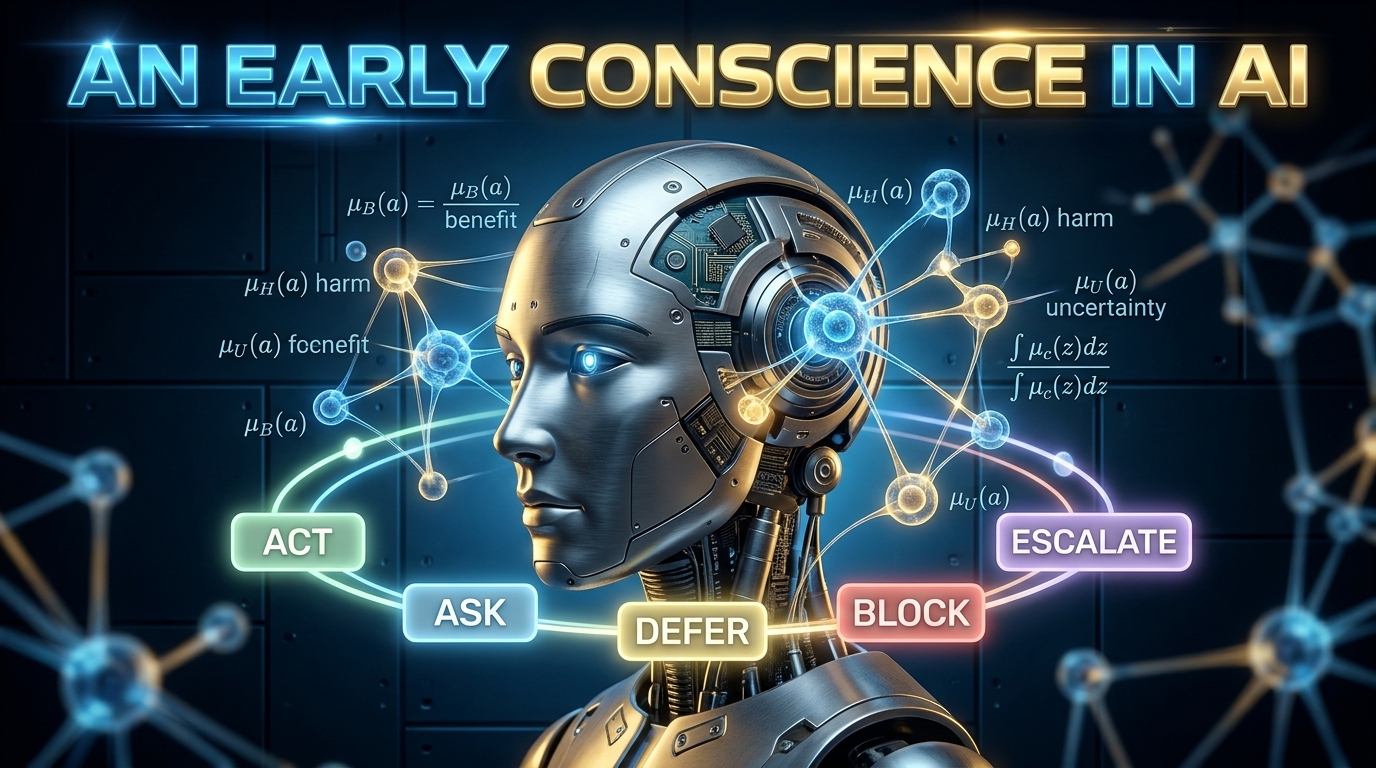
This chapter introduces the concept of a functional early conscience for artificial intelligence: an engineered pause between computational evaluation and action. Inspired by the role of silence in acoustics, this pause allows an intelligent system to examine the conflict within its proposed decision before releasing an output. The chapter distinguishes conscience from consciousness and argues that a machine may demonstrate structured restraint without possessing subjective experience, emotion, guilt, or moral personhood. Fuzzy logic is employed to represent overlapping degrees of benefit, harm, uncertainty, irreversibility, and authorization rather than reducing ethical conflict to rigid binary rules. Within the ENOSH architecture, these evaluations interact with the Five Books: the Watchers examine constraints and permissions; the Parables retrieve precedents; the Luminaries represent declared values; the Predictions estimate consequences; and the Dream Visions generate counterfactual alternatives. The resulting process converts graded internal evaluation into one of five governed responses: act, ask, defer, block, or escalate to an authorized human. The chapter also distinguishes emotion recognition from genuine emotional experience and emphasizes that apparent empathy must not be confused with responsible conduct. A practical testing framework is proposed to evaluate constraint compliance, appropriate deferral, uncertainty calibration, explanation fidelity, correction retention, and adversarial resistance. The early conscience is therefore presented not as evidence of machine consciousness, but as a testable engineering architecture designed to make artificial intelligence interrupt unsafe momentum, expose uncertainty, preserve accountability, and recognize when the power to act must be replaced by the responsibility to stop.