Autonomous Personalized Cinema: A Narrative Review and Conceptual Framework for AI-Generated Films Tailored to Individual Viewers
DOI:
https://doi.org/10.66661/ENOSH-2026-003Keywords:
AI-generated film, , autonomous personalized cinema, runtime creative autonomy, viewer digital twin, visual-attention mapping, temporal preference modeling, generative preference memory, multi-agent filmmaking, psychoacoustics, responsible AI.Abstract
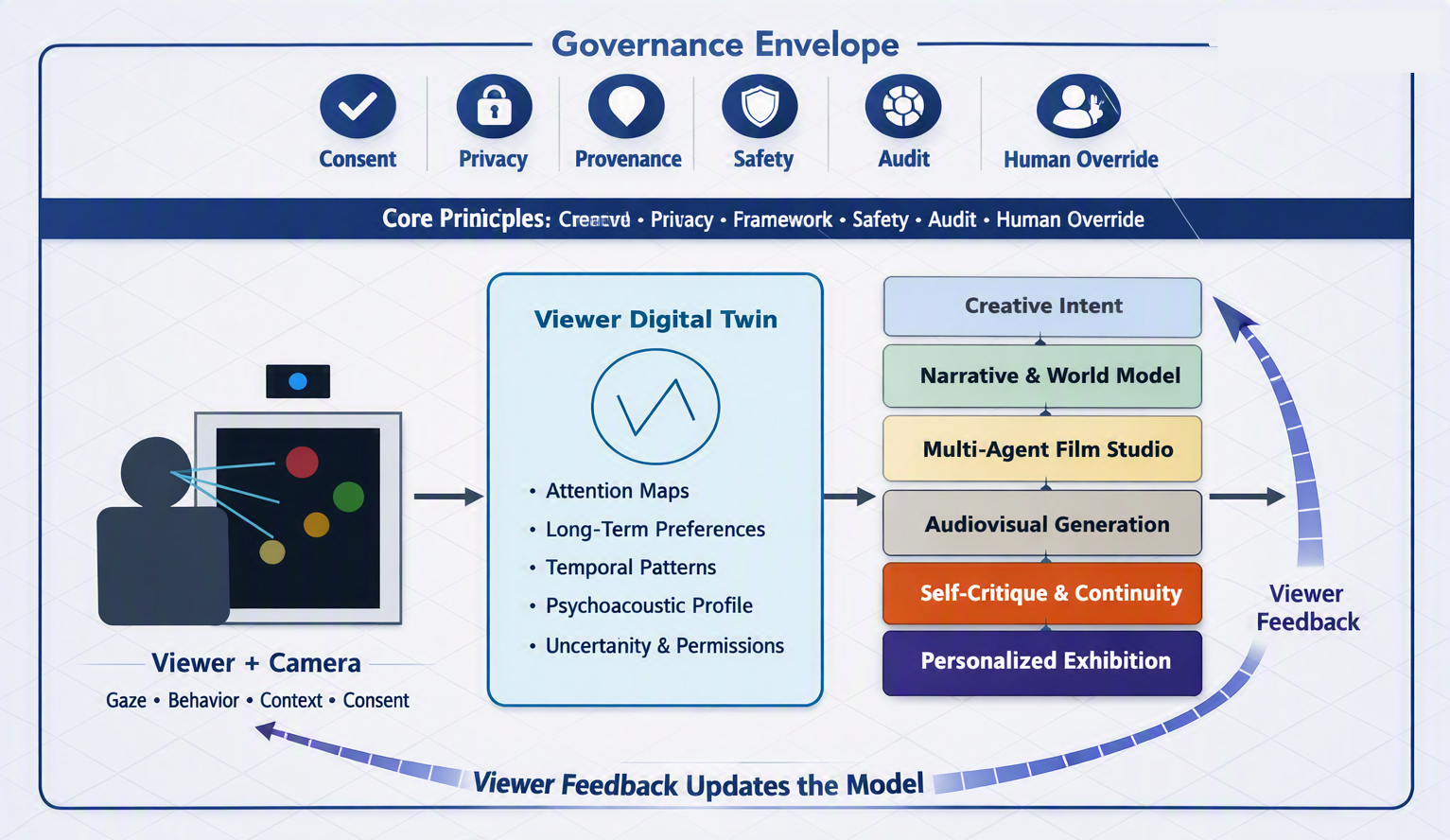
Artificial intelligence is increasingly used in screenplay development, visual production, editing, sound generation, audience analysis, recommendation, and media personalization. These applications, however, remain fragmented and largely dependent on human-directed workflows. This narrative review examines the technical, creative, cognitive, evaluative, and ethical conditions under which an artificial-intelligence system could achieve runtime creative autonomy and generate a complete film for an individual viewer. The study synthesizes research across computational creativity, long-form narrative generation, multimodal media synthesis, multi-agent production, viewer modeling, digital twins, visual-attention analysis, temporal recommendation, psychoacoustics, spatial audio, and responsible artificial intelligence. It proposes Autonomous Personalized Cinema as a computational filmmaking paradigm in which an AI system independently plans, generates, evaluates, revises, and delivers a coherent audiovisual narrative within declared human-governance constraints. A seven-layer framework is introduced, comprising a Viewer Digital Twin, Creative Intent Engine, Narrative and World Model, Multi-Agent Virtual Film Studio, Audiovisual Generation Engine, Self-Critique and Continuity System, and Personalized Exhibition Layer. The Viewer Digital Twin is extended through optional camera-based gaze mapping, behavioral observation, contextual and temporal preference modeling, and a Generative Preference Memory that stores abstract attributes of favored characters, environments, narratives, and sound experiences rather than copies of existing works. The framework rejects absolute independence from human institutions and defines autonomy specifically at the point of creative execution. It emphasizes consent, local processing, data minimization, uncertainty, viewer control, provenance, similarity screening, and protection against manipulation. The resulting framework provides a theoretical architecture, research questions, testable propositions, and a staged validation programme for the future development of autonomous AI-generated cinema.